
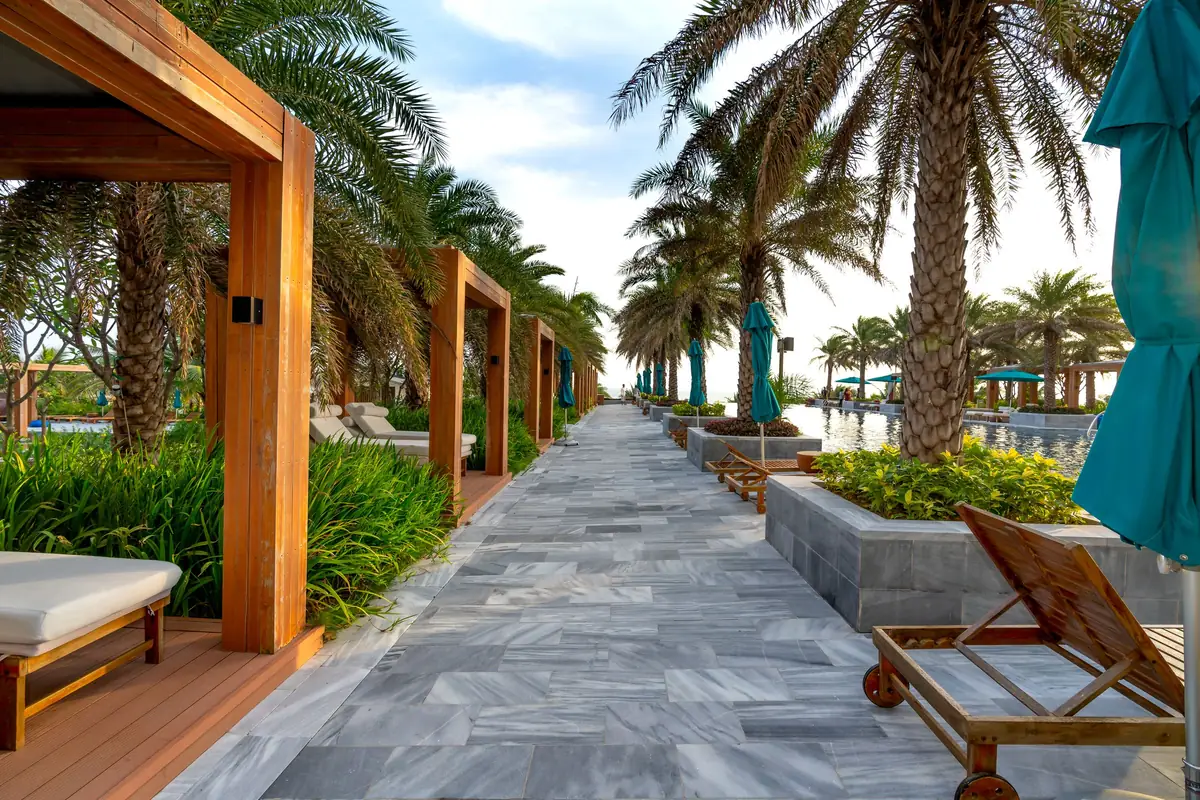
For a Florida pool deck, choose a light color, a textured top and a well-compacted base. Then pick among concrete pavers, travertine and porcelain. In one pool builder's side-by-side test, color changed how hot a deck felt more than the material did. Porcelain has very low absorption, according to its maker. Xtreme Scapes builds pool deck pavers in all three across Brevard County.
Start with heat: color matters more than material
Pool decks are walked on barefoot, so check heat first. River Pools, a fiberglass pool builder, took temperature readings on six patio materials on a Virginia day with a heat index of 108 degrees. The six were textured concrete, gray pavers, earth-tone pavers, bluestone, cream travertine and beige travertine. Its takeaway: patio temperature "is more a consequence of color than the actual material".
That was one video on one day in Virginia. It was not a lab study, and it did not test porcelain. Use it as a reason to choose color before material, not as proof that any stone runs cool. Belgard, a paver maker, adds a number for light colors: pavers that qualify for heat island credit need an initial solar reflectance of 0.33 or higher. Ask any supplier for the reflectance of the exact color you are considering, then stand a sample in midday sun before you order.
Wet grip: ask for the traction number, not the photo
Pool decks get wet, so grip matters as much as heat. The tile industry measures wet traction with a test called dynamic coefficient of friction, or DCOF, set out in ANSI A326.3. Tile maker Crossville explains that 0.42 is the industry benchmark for level interior floors walked on when wet, and warns that a surface at or above that number is "not necessarily suitable for all projects."
For outdoor wet areas, Crossville's "Exterior Wet" category typically pairs an elevated wet DCOF with "an enhanced or exaggerated surface texture" and lists pool decks as a possible use. Belgard says the textured tops on its porcelain pavers are skid-resistant and "perfect for around pools/spas or in wet climates". Treat that as a manufacturer's claim. Ask for the wet DCOF number and the finish name on every paver on your list, concrete and travertine included, and compare numbers instead of photos.
Travertine vs concrete pavers
Travertine is natural stone, and every true travertine has holes. The Natural Stone Institute's technical office says all true travertines have voids within the stone fabric from trapped gases formed as the stone was made. Fabricators can fill the voids or leave them open, and the institute says filling with cement-based or resin filler is now much more common. Voids that sit just under the face are not filled. It names rolling loads from hard wheels and spike heels as two common causes of fractures over them. On a deck, picture a loaded cart with hard wheels or a heavy planter on a dolly.
Concrete pavers are the other common choice. The Concrete Masonry & Hardscapes Association (CMHA) is a trade group that promotes pavers, so weigh it that way. It says concrete pavers are made with two to three times the strength of typical poured concrete because they cure in a climate-controlled factory. Belgard's guide sets them on a nominal 1 inch of bedding sand over a compacted base. It recommends polymeric jointing sand, which helps to stabilize the sand in the joints and control insects and weeds.
One thing to expect with concrete pavers: a white haze called efflorescence. Belgard says it can appear within months of installation, may wear away, and does not affect the structural performance or durability of the pavers. Know about it before the first summer so it does not surprise you.
Porcelain pavers: very low absorption, a different install
Porcelain pavers are pressed and then fired. Belgard describes its porcelain pavers as fused at temperatures above 2,240 degrees Fahrenheit into a product with an "ultra-low absorption rate." Each unit is 20 millimeters, about three-quarters of an inch, thick. Belgard also says the low absorption means spills and salt do not seep in, and that color is fused into the surface instead of applied to it. Those are the maker's claims. If stains and salt worry you, ask how porcelain compares.
The install is not the same as for concrete pavers. Belgard's guide says to never compact porcelain pavers with a plate compactor. The sand bed under them is pre-compacted and struck off to a set thickness, and the pavers are set into it. If you are comparing bids, ask each installer how often they set porcelain.
Sandy ground and rain: why the base matters
Most of Florida is sand. UF/IFAS says Florida soils are predominantly sandy, often exceeding 85% sand, with limited water-holding capacity. The pavers sit on whatever the ground and the base give them, which makes the base the part of the job to ask about.
Belgard's installation guide gives the baseline for pavers on a patio or deck. Excavate at least 8 inches below finished grade, compact the subgrade to 98% standard Proctor density, and slope it 1 to 2% in the direction you want water to go. Then add 4 to 8 inches of base material, compacted in 2 to 4 inch lifts. The guide sets a minimum surface slope for drainage of 2%, and says pavers installed with a 2% pitch will drain quickly. Belgard notes the depth of the base is "subject to site specific conditions," so a written estimate that names the base depth is a better sign than a low square-foot number.
Salt is the other local factor. A UF/IFAS coastal landscaping guide sets about one-eighth of a mile from saltwater as the distance inside which plants need at least some salt tolerance. It is written for plants, not pavers. If your pool is that close to saltwater, put salt on the list of questions when you compare materials. Which Brevard neighborhoods fall inside that distance is a question for a site visit, not a rule of thumb.
Matching the paver to the use
| Concrete pavers | Travertine | Porcelain | |
|---|---|---|---|
| Made from | Concrete, cured in a factory | Natural stone with voids, usually filled | Sand, quartz, feldspars, kaolin and clays, per Belgard, pressed and fired above 2,240 degrees F |
| Watch for | White efflorescence in the first months | Fractures over unfilled voids under hard-wheeled loads | Needs a pre-compacted sand bed, never a plate compactor |
| Wet grip | Ask for the DCOF number and finish | Ask for the DCOF number and finish | Textured tops, per Belgard; still ask for the number |
For a pool deck, start with color and texture, then pick the material that fits your budget and the look of the house. If your project is the driveway, not the deck, read pavers vs. concrete for a Brevard driveway. The wheels and loads are different.
Five questions to ask before you pick
Take these to every supplier and installer you talk to.
- What is the solar reflectance of this exact color?
- What are the wet DCOF number and the finish name?
- If it is travertine, are the voids filled, and with what?
- How deep is the base, and how is it compacted on sandy ground?
- How often do you set porcelain, and how do you bed it?
Get the answers in writing, and question any bid that cannot give them.
Next step: a measured deck and a written estimate
Xtreme Scapes does paver work in concrete, brick, travertine, porcelain and natural stone for pool decks, patios, walkways and driveways. The process starts with an on-site visit where we measure, check the existing surface and base conditions, and give you an itemized written estimate. Ask for a free estimate, and bring the color and finish you are leaning toward.
See what our Paver Installation service includes in Brevard County.
Sources
- River Pools and Spas: How Hot Do Swimming Pool Patios Get? Temperature Comparison
- Crossville: Porcelain Tile DCOF Ratings and Applications
- Natural Stone Institute: Travertine Voids (technical handout)
- Concrete Masonry & Hardscapes Association: Pavers vs. Concrete: Myths, Facts, and What Homeowners Need to Know
- UF/IFAS Extension: Impact of Climate Change on Florida's Soil Health (SL544/SS760)
- UF/IFAS Gardening Solutions: Coastal Landscapes
- Belgard: Technical Resource Guide (product installation guide), page 6: Paver Installation Recommendations
- Belgard: Technical Resource Guide (product installation guide), page 7: Paving Systems Installation Guide
- Belgard: Technical Resource Guide (product installation guide), page 8: Compacting the Pavers and Joint Sand
- Belgard: Technical Resource Guide (product installation guide), page 9: Paver Maintenance
- Belgard: Technical Resource Guide (product installation guide), page 25: Porcelain Pavers
- Belgard: Technical Resource Guide (product installation guide), page 26: Porcelain Paver Installation