
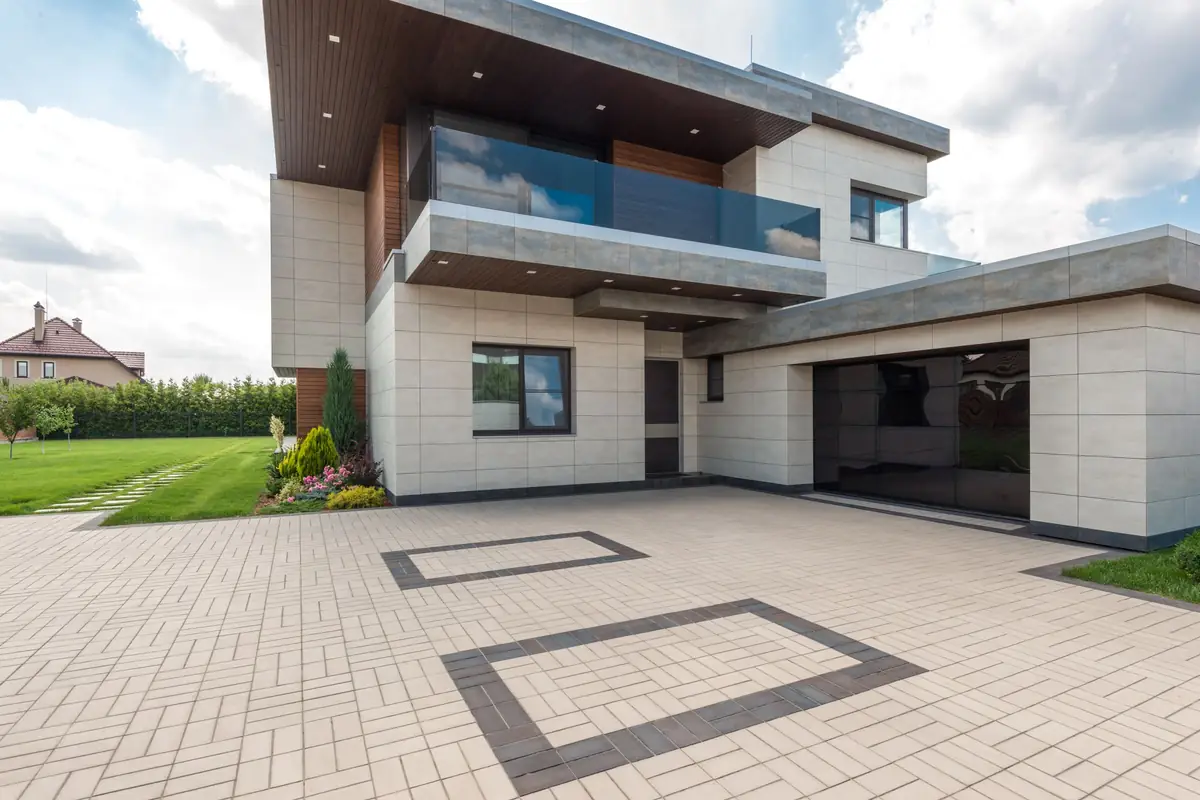
Concrete often costs less up front, and a cracked or sunken paver area can be lifted and reset instead of cut out and re-poured, according to the trade group for paver makers. Xtreme Scapes installs paver driveways across Brevard County. Whichever surface you pick, ask about the base first.
Cracking and repair: where pavers and concrete differ
Concrete is built to crack, just in chosen places. Paul Fisette of the University of Massachusetts explained in a 2005 Fine Homebuilding Q&A that control joints are a deliberate plane of weakness, spaced every 10 to 12 feet and cut about one-quarter of the slab's depth. In his words, as the slab shrinks, it cracks along these predetermined lines.
The Concrete Masonry & Hardscapes Association (CMHA) argues the other side, so weigh its view as a trade group's. It calls cracking in poured concrete "practically inevitable". It says repairing a slab usually means cutting out and disposing of the damaged section, pouring new concrete and waiting days for it to cure, which often leaves a visible patch. For pavers, it says individual units can be removed, the bedding or base adjusted and the pavers replaced.
Pavers are not crack-proof. Belgard's guide says broken or cracked pavers that affect performance can be removed and replaced. It describes interlocking pavement as flexible pavement that spreads a load through the base to the soil below, with the pavers interlocking to share it. Ask how the installer would replace a cracked unit and what base sits under it.
| Concrete slab | Paver driveway | |
|---|---|---|
| How it cracks | Along planned joints as it shrinks, per Fine Homebuilding | Units can crack and be replaced, per Belgard |
| Repair | Cut out, re-pour, wait for cure, per CMHA | Lift, adjust the base, reset the pavers, per CMHA |
Why a paver driveway holds together
Belgard's guide names three kinds of interlock: vertical, rotational and horizontal. Vertical interlock comes from the sand in the joints, which shares loads between neighboring pavers. Rotational interlock comes from paver thickness that suits the load and from a perimeter edge restraint. Horizontal interlock comes from laying patterns that spread the forces of braking, turning and accelerating vehicles, and the guide says herringbone patterns should always be used in vehicular applications. It also lists consistent joint widths of about 1/8 inch among the variables that affect performance.
Ask the installer to put the pattern, joint sand and edge restraint in the bid.
What a driveway base has to carry
A driveway carries cars, so the base is thicker than under a patio. Belgard's installation guide lists a compacted aggregate base of at least 6 inches for a residential driveway, against 4 inches for patios and walkways. The same page ties the depth to the conditions on the site, so treat 6 inches as a floor. The guide also lists 2 3/8 inches as the minimum paver thickness for driveways.
Traffic changes the answer. Belgard's residential driveway category covers cars and light use, with heavy vehicles averaging under one a day. The guide adds that a pavement design professional should confirm the paver suits the subgrade, slope, drainage and traffic loading. If a loaded boat trailer, an RV or a delivery truck will park on it, tell the installer before the estimate, not after.
Edges need support too. Belgard names a non-moving fixed edge restraint as one of the variables that affect performance, and its installation steps list spiked plastic, steel or aluminum edging, or poured-in-place concrete curbs as options. Ask which one the bid includes.
Paver driveway cost: what moves the number
A written estimate after a site visit sets the real number for a paver driveway. Ask the installer to price these items on separate lines, so you can see where the money goes.
- The base. Its depth, and any digging or hauling it needs.
- The paver. For how the surfaces compare on heat and grip, see best pavers for a pool deck.
- The edges. The type of edge restraint and how many feet of it.
- Removal. Whether an existing slab or asphalt has to come out first.
- Size and shape. The total area, and any borders, curves or inlays.
CMHA says poured concrete often has a lower initial cost and argues pavers win on long-term value through repairability and lifespan. That is the trade group's view, and it is a fair question to put to any installer for your own lot.
Design, stamping and permeable options
CMHA says pavers allow borders, medallions, curves and inlays, and that stamped concrete cannot be changed once it is poured. Its engineering VP warns that the color on stamped slabs is often applied to the surface and will wear away or spall off with traffic. That is one trade group's view of stamped concrete, so ask any installer how the color is applied and what the wear history is. CMHA adds that pavers can be rearranged, replaced or expanded later, and that removed pavers can be cleaned and reused elsewhere.
If stormwater rules or water restrictions apply where you live, CMHA notes that permeable paver systems can help properties meet municipal requirements. Ask your building department whether that matters for your lot.
Stains and upkeep
Oil is the driveway problem. Belgard says dirt, wear and food and oil stains affect a paver surface over time, and that stains should be treated quickly with a cleaner and brush suited to the stain. It says a sealer can protect pavers from food and oil stains, and that sealers should go on after a year of service so any efflorescence can fade first. CMHA says sealers on concrete and pavers both help with stain removal and both need upkeep every few years.
Pavers need their own upkeep. CMHA lists cleaning the surface, sweeping in sand and removing weeds. Belgard says joint sand loss of more than half an inch calls for replacing the joint fill, and that loss can occur where there is wind, surface-water scour, vehicular traffic or a slope.
Permits and HOA rules: what to ask first
Permit rules are local, so here is one Brevard example. The City of Rockledge's building department publishes a "Driveway and Pavers" sheet listing a completed permit application and a survey or site plan showing the driveway or pavers, plus a recorded notice of commencement if the job is over $2,500. For pavers in the city right-of-way, the same sheet says City Manager approval is required. It also says to call 1-800-432-4770 for an underground utility locate before you dig. The sheet is undated and sits under the city's rules for work in public ways, so confirm what applies to your lot.
For Melbourne, Palm Bay, Cocoa or the unincorporated county, call the building department and ask three things. Does a paver driveway need a permit? Does the apron or any work in the right-of-way need separate approval? Does the owner or the contractor pull it? If you live in an HOA, ask for its driveway rules in writing before you order anything.
When concrete is the right call
Concrete may be the better call if budget comes first, the shape is simple and you can live with cracks along joints. Fisette's point is that a well-jointed slab cracks where it was told to. Xtreme Scapes also does concrete and stonework, so the choice does not have to be settled on the phone.
If you are leaning toward pavers, ask Xtreme Scapes about a paver driveway and request the base depth, paver, edge restraint and drainage written on separate lines. That is how you compare a paver bid to a concrete bid.
See what our Paver Installation service includes in Brevard County.
Sources
- Concrete Masonry & Hardscapes Association: Pavers vs. Concrete: Myths, Facts, and What Homeowners Need to Know
- Fine Homebuilding: Control vs. Isolation Joints in a Concrete Driveway
- City of Rockledge Building Department: Driveway and Pavers
- Belgard: Technical Resource Guide (product installation guide), page 6: Paver Installation Recommendations
- Belgard: Technical Resource Guide (product installation guide), page 7: Paving Systems Installation Guide
- Belgard: Technical Resource Guide (product installation guide), page 9: Paver Maintenance
- Belgard: Technical Resource Guide (product installation guide), page 10: Understanding Interlocking Concrete Pavement
- Belgard: Technical Resource Guide (product installation guide), page 23: How to Select the Right Paver for Your Application